
Real Prayer
The Heart Behind the Words: What Prayer Is Really About
Prayer is one of the most universally practiced human behaviors. Across every culture, every religion, every corner of the world, people pray. They bow their heads, fold their hands, kneel toward sacred directions, spin wheels, light candles, and lift their voices. But the staggering reality is this: the act of praying and the act of truly communing with the living God are not always the same thing. And that distinction changes everything.
In Matthew 6:5-8, Jesus confronts a deeply uncomfortable truth about the prayer lives of the most outwardly religious people of his day. The Pharisees were not casual about prayer. They were devoted to it. They prayed in the morning, during the day, and at night. Their prayers were elaborate, lengthy, and impressive. And yet Jesus looked at all of it and called it empty. Not because they were praying too much, but because they were praying to the wrong audience entirely.
A Show for the Wrong Crowd
Jesus identifies the core problem plainly. The religious leaders of his day loved to pray where they could be seen. They chose the synagogues and the street corners, the places where crowds gathered, because the applause of men was what they were truly after. And Jesus does not mince words about what that means: they have their reward in full. God was not listening. The contract, so to speak, had already been fulfilled, and it had nothing to do with heaven.
This is a sobering thought. It is entirely possible to pray loudly, pray publicly, pray with great vocabulary and impressive length, and have God not be the one receiving any of it. Prayer that is performed for human admiration is not prayer at all. It is theater.
The issue, as Jesus makes clear, is never the location or the posture. Jesus himself prayed in public. He prayed in the synagogues. He prayed with his disciples. The issue is always the heart. Are the words being directed toward God, or toward the people within earshot?
The Secret Place
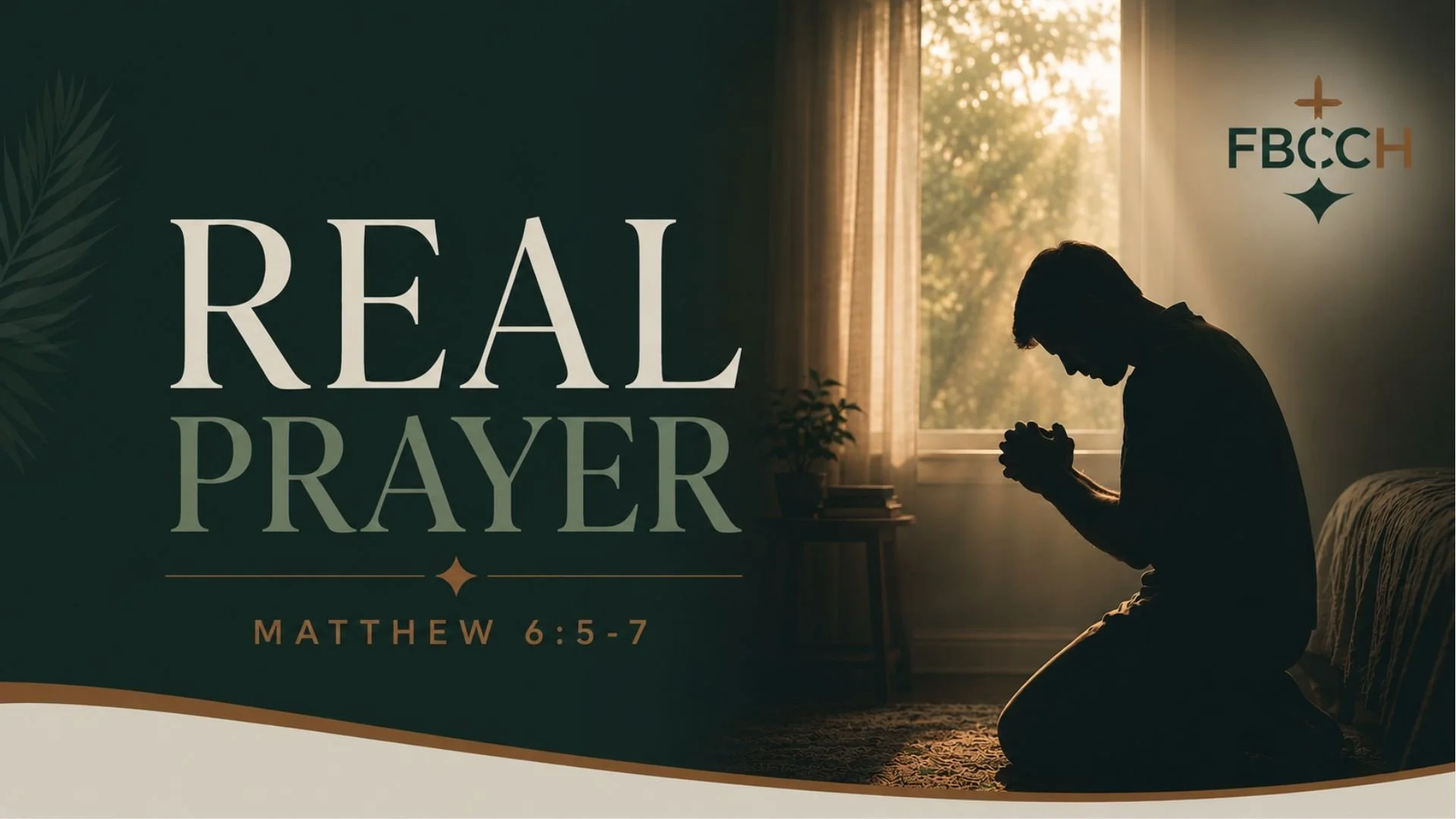
Jesus then gives a striking instruction in verse 6. He tells his followers to go into their inner room, close the door, and pray to the Father who is in secret. The Father who sees in secret will reward openly.
This is not a prohibition against corporate prayer or public prayer. The church gathering together in prayer is commanded throughout Scripture. Rather, Jesus is pointing to something essential: there must be a private, intimate dimension to your prayer life. A place where no one is watching. A place where there is no audience to impress, no reputation to protect, and no performance to maintain. Just you and the Father.
That word "Father" is worth pausing on. This is not a distant deity who must be worn down into responding. This is not the God of the philosophers, cold and untouchable behind the stars. This is a Father. Personal. Near. Attentive. The relationship Jesus describes is not one of a petitioner trying to get an audience with a reluctant king. It is a child coming to a Father who already loves them.
The Pagan Pattern
In verse 7, Jesus addresses another failure mode: vain repetition. He warns against praying the way the Gentiles do, heaping up words under the assumption that God will be moved by sheer volume. The underlying belief in pagan prayer is that the gods are either absent, distracted, or unwilling, and that enough noise will eventually force a response.
The account of Elijah and the prophets of Baal in 1 Kings 18 paints this picture vividly. The prophets of Baal cried out all day long, working themselves into a frenzy, louder and louder, while Elijah looked on. Then Elijah prayed. His prayer was simple, heartfelt, and direct. Fire fell from heaven. The contrast could not be more stark. One side produced noise. The other produced communion with the living God.
This pattern, Jesus warns, can creep into the lives of genuine believers too. The temptation to equate spiritual intensity with spiritual effectiveness is real. But God does not need to be worn down. He is not asleep. He is not on vacation. He is your Father, and he already knows what you need before you ask him, as verse 8 makes clear.
Why Pray at All?
This raises an honest question. If God already knows what we need, why pray? The answer lies in understanding what prayer actually is. Prayer is not a mechanism for delivering information to an uninformed God. It is communion. It is relationship. It is the continuation of what was lost in the Garden of Eden, when Adam and Eve walked with God in the cool of the day, restored through Christ.
God is sovereign. His purposes will not be thwarted. And yet, woven into the fabric of his sovereignty is a genuine invitation to his people to come to him, to bring their needs, their fears, their confusion, and their gratitude before him. Hezekiah prayed when God told him he would die, and God gave him fifteen more years (2 Kings 20:1-6). The sovereignty of God and the genuine nature of prayer are not in contradiction. They exist together in the mystery of a God who desires relationship with the people he has made.
A Heart Cry, Not a Performance
True prayer, the kind Jesus calls his followers to, is a heart cry before a holy God. It is not about impressing anyone. It is not about the right formula or the right length or the right location. It is about coming to the Father honestly, humbly, and with genuine faith that he hears and that he cares.
Psalm 34:8 describes an invitation to taste and see that the Lord is good. That is the spirit of prayer. Not a desperate attempt to get God's attention, but a trusting response to a Father who is already attentive, already near, and already good.
The question worth sitting with is not whether you pray. Almost everyone does. The question is who you are actually praying to, and whether your heart is truly in the room.
The sermon describes prayer as communion with God rather than a technique for getting what we want -- in what ways might your own prayer life reflect genuine communion versus an attempt to persuade or pressure God into action?
Jesus confronts the Pharisees not for praying publicly but for praying with the wrong heart -- how do you discern whether your own public expressions of faith are motivated by a desire to honor God or to be seen by others?
The sermon draws a sharp contrast between the babbling repetition of pagan prayer and the heartfelt simplicity of Elijah's prayer that brought fire from heaven -- what does this contrast reveal about what God actually values when we come to him in prayer?
The pastor argues that the only prayer God hears from a non-believer is a cry for salvation -- how does this understanding of who God listens to shape the way you think about interceding on behalf of unbelievers in your life?
God is described as sovereign yet responsive, as seen in the account of Hezekiah receiving fifteen more years after crying out -- how do you hold together the tension between God's unchanging will and the genuine power of prayer to influence outcomes?
The sermon suggests that trusting God more, rather than having greater faith, is what builds a deeper prayer life -- what is the difference between these two things, and how might that distinction change the way you approach your relationship with God?
The story of the evangelist and Jack illustrates how a detailed, heartfelt public prayer led to an unexpected act of redemption -- what does this account suggest about the ways God uses corporate prayer beyond what those praying could have anticipated?
Jesus says in Matthew 6:8 that the Father already knows what we need before we ask him -- if that is true, what is the purpose of prayer, and what does it mean for how we should approach God with our needs?
The sermon warns that meaningless repetition can creep into Protestant worship just as it did into the religious practices Jesus condemned -- what are some specific ways that modern Christian prayer habits might drift toward empty ritual without people realizing it?
The pastor describes Christianity not as a religion but as a relationship with the living God, rooted in the kind of communion Adam and Eve had with God in the garden -- what would it look like practically for your prayer life to reflect that kind of intimate, ongoing relationship rather than a formal religious obligation?